There are cities where steel once roared, where smoke billowed like the breath of titans from towering chimneys—and then, quietly, nature reclaims the edges. Pittsburgh is such a place. What once was the mighty heart of American industry now cradles some of the most serene, verdant sanctuaries I’ve wandered through in recent years.
This visit brought me into communion with hills that roll like whispered lullabies, rivers that mirror the sky, and trails that cut through forest like quiet intentions. Over a week in the city, I walked, hiked, sat, listened, and, most importantly, paid attention. Here is where my boots took me—through ten green refuges where Pittsburgh breathes differently.
1. Schenley Park: The Grand Matriarch of Green
There is something regal about Schenley Park. The entrance, if you follow Forbes Avenue past the University of Pittsburgh, opens like a gateway into a more gracious time. Winding drives are framed by hundred-year-old oaks; stone bridges arch over ravines; and trails meander with the authority of an old city that trusts you to find your own way.
I started at the Phipps Conservatory and Botanical Gardens, a glass jewel that feels almost too ornate to be real. Stepping inside was like entering a greenhouse designed by a Romantic poet with an engineering degree—everything precise, yet emotionally rich. The Tropical Forest Conservatory was alive with the scent of wet soil and orchids, while the Desert Room had the quiet dignity of a cathedral.
The trails outside offered their own poetry. Panther Hollow Trail took me down a wooded ravine, where cardinals flickered like live coals among the trees. A small bridge spanned a narrow stream, and the hush was profound. At the overlook, the skyline of Oakland shimmered through the leaves, a visual reminder that even nature here is in conversation with the city.
2. Frick Park: The Wild East
Frick Park doesn’t try to charm you; it confronts you with its wildness. It’s the largest of Pittsburgh’s parks, and parts of it feel like unfiltered Appalachia. I entered from the Regent Square side, where tidy houses line the streets, and within minutes I was deep among tall tulip poplars, the city sound swallowed by canopy.
The Riverview Trail cut through deep woods, where deer moved like ghosts and squirrels conducted their acrobatics with suspicious indifference. Every turn felt personal—less like following a map and more like uncovering a story someone had left behind. I crossed Nine Mile Run, the water flowing clear over a bed of stones that had seen a century of change.
At Blue Slide Playground, I watched families play while a jazz musician practiced saxophone under a tree. It was an odd but comforting juxtaposition. Frick Park manages to be many things at once—a playground, a forest, a conservation space, and a reminder that Pittsburgh doesn’t need to choose between wilderness and civilization.
3. Point State Park: Where Rivers Converse
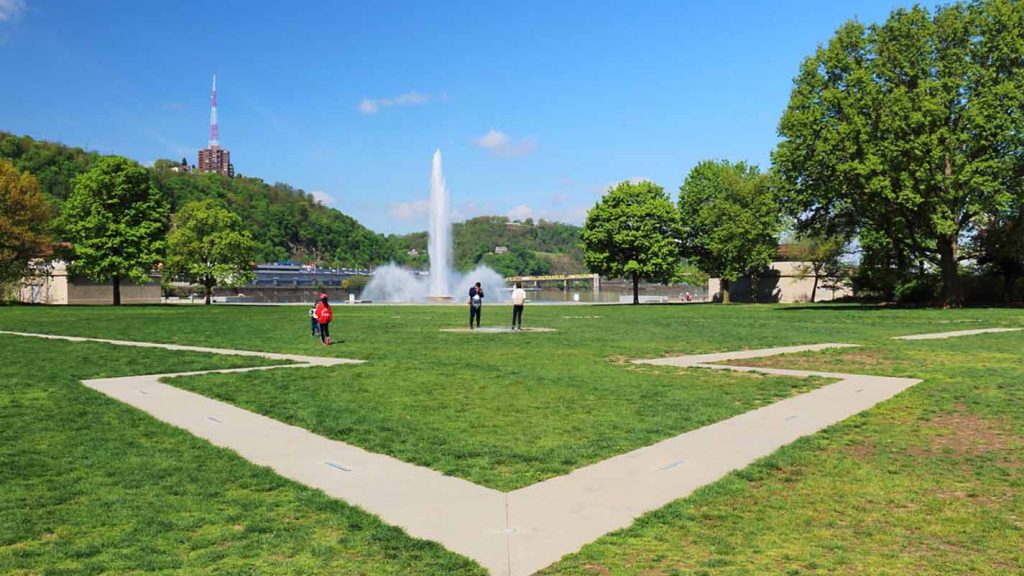
No park in the city carries quite the symbolic weight of Point State Park. It’s here, at the tip of the Golden Triangle, that the Allegheny and Monongahela Rivers join to form the Ohio. The city pivots around this confluence, and so did I. Standing there felt like standing on the axis of a wheel.
The fountain at the park’s edge is unmissable, jetting water high into the air, as if announcing the city’s pride to the heavens. But the real beauty lies in the perspectives. Walk the perimeter, and every few feet offers a different view—the stadiums across the river, the inclines of Mount Washington, the steel bridges like ribbons tying the city together.
I sat under the shade of a tree and watched boats drift lazily past, and for a moment, the historical weight of the Fort Pitt Block House, the oldest structure in Pittsburgh, seemed to blend with the scent of hot dogs from a vendor and the laughter of children chasing bubbles. It’s a park layered in time.
4. Highland Park: Grace in Symmetry
Highland Park feels curated. There’s a formality to its layout, a symmetry in the design that nods to an older sensibility of what public spaces should be. I entered through the ornamental entrance garden, where wrought-iron gates open into tree-lined walks. It reminded me of parks in European capitals—civilized, intentional.
The central reservoir, framed by a walking track, reflected the sky like a Monet painting. People jogged by with purpose, dogs tugged at leashes, and the occasional stroller creaked over pebbled paths. The Japanese-style garden area was a delicate touch—maples and stone lanterns and a bench where time seemed to slow.
Highland Park is also home to the Pittsburgh Zoo & Aquarium, and while I didn’t enter this time, the distant calls of animals were faint but present, like a memory you’re trying to recall but never quite do. The park serves as a gentle anchor on the city’s East End—a place that holds itself with dignity.
5. Emerald View Park: Pittsburgh’s Balcony
Some places are about perspective. Emerald View Park offers not just green space, but the kind of views that rearrange your understanding of a city. Climbing up Mount Washington on foot is an endeavor worthy of its reward—and the reward is this park.
Once known for the inclines and steel mansions, the area now holds trails that trace the ridge line, with sudden clearings that offer cinematic panoramas of Pittsburgh. From the Grandview Overlook, I watched the city light up slowly as dusk settled in—skyscrapers catching the last of the sun, rivers turning to ink, and headlights tracing the bridges like fireflies.
The trails were less crowded than I expected. I passed a man walking his greyhound and an older couple identifying birds with binoculars and whispered precision. Wildflowers bloomed in quiet corners. Every so often, the rumble of the incline cars would drift over, a reminder that beauty and labor have always shared this hill.
6. Riverview Park: Observatory of Pines
On the North Side of Pittsburgh lies a park with a different character—less manicured, more elemental. Riverview Park is defined by its topography: steep slopes, deep woods, and winding trails that demand a bit of effort. But the payoff is substantial.
At its heart sits the Allegheny Observatory, a gleaming white neoclassical building that looks like it wandered in from another century. I arrived just as the sun began its descent, casting long shadows across the lawn. The air had that high-country clarity I associate more with mountain towns than urban centers.
I wandered the Perry North Trails, and the scent of pine was sharp and real. Dogs barked from a distance. Somewhere, a hawk called out overhead. The sense of quiet here is rich—not absence of sound, but presence of stillness. From a small clearing, I caught sight of the Observatory dome gleaming above the trees, like a sentinel watching over Pittsburgh.
7. Mellon Park: Quiet in the City’s Heart
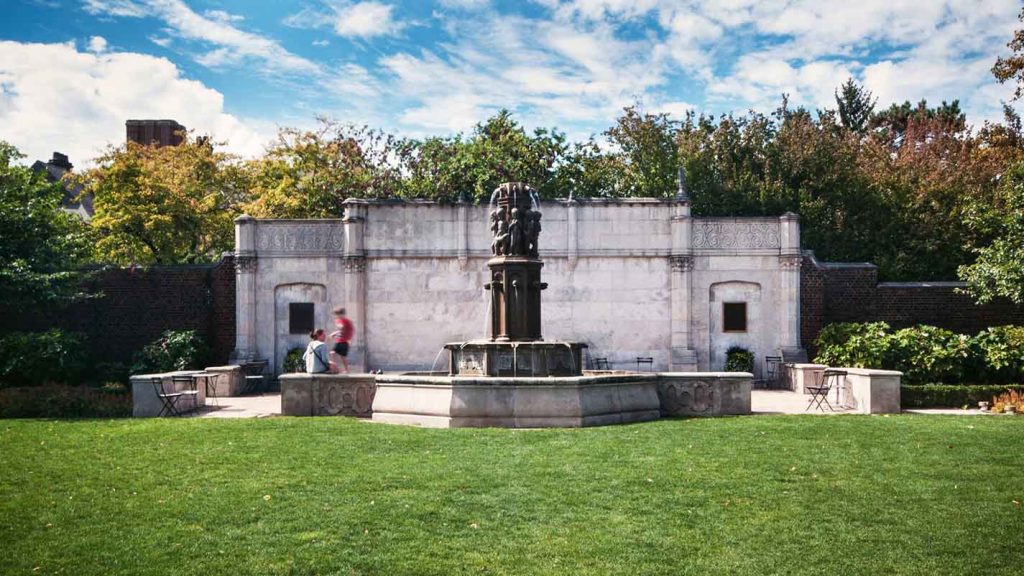
Mellon Park is small compared to giants like Frick or Schenley, but what it lacks in size, it makes up for in intimacy. Located in the Shadyside neighborhood, this park blends gardens, sculptures, and quiet spaces into a kind of urban pocket sanctuary.
What drew me in first was the Walled Garden, where rows of flowers bordered a lawn laid out with silent intention. Children played under the watchful eye of a bronze sculpture, and on benches, people read with the kind of focus that only comes when a place feels genuinely calm.
The real surprise was underfoot. As dusk approached, tiny lights embedded in the lawn began to glow—part of the “Stars” installation, representing a map of the night sky as it appeared the day a local woman was born. It was poignant without being sentimental, and it caught me off guard.
Mellon Park reminded me that nature doesn’t always need to roar or expand endlessly. Sometimes it just needs to be close.
8. South Side Riverfront Park: Linear Sanctuary
The South Side of Pittsburgh has an edge—gritty, post-industrial, a little unpredictable. But right alongside the Monongahela River, there’s a park that unfolds like a quiet answer to all that noise. The South Side Riverfront Park stretches for miles, a narrow ribbon of green that feels stitched into the fabric of the riverbank.
I began my walk near the Hot Metal Bridge, the steel structure towering overhead, the hum of traffic above like a mechanical heartbeat. But within moments, I was on a crushed limestone trail, flanked by trees and the occasional wild thistle.
Cyclists whirred past, and kayakers moved downriver in quiet rhythm. The park offers not spectacle, but continuity. It’s the kind of place that gives you time to think. I paused at a small overlook, watching a heron pick its way along the water’s edge. There’s resilience here—in the grasses pushing through stone, in the trees reclaiming forgotten lots, and in the city itself.
9. Herrs Island / Washington’s Landing: Industrial Rebirth
Herrs Island, or Washington’s Landing as it’s now called, sits in the Allegheny River like a chapter that’s been carefully rewritten. Once an industrial wasteland, it has transformed into a clean, quiet retreat with a marina, walking trails, and a kind of refined stillness.
I arrived by foot, crossing the pedestrian bridge from the Strip District. The island felt oddly European—clean lines, riverside cafes, landscaped trails. I followed the Heritage Trail loop, which circles the island and offers uninterrupted views of the river and skyline. Cyclists nodded as they passed, and a fisherman cast his line into the water with a motion that looked almost ceremonial.
A restored boathouse stood at one end, and as the sun slipped lower, I saw teams rowing down the river—backs straight, oars in sync, gliding past like time itself. Herrs Island isn’t wild, but it’s no less vital for its polish. It’s proof that even land with a rough past can wear its future with grace.
10. Bird Park & Twin Hills: Suburban Solace
On Pittsburgh’s South Hills lies a small but cherished patch of wilderness—Bird Park and the adjoining Twin Hills. These aren’t dramatic parks. There’s no skyline, no rivers, no observatory domes. What they offer instead is intimacy.
I wandered Bird Park’s loop trail early in the morning, dew still heavy on the grass. Birds were indeed everywhere—robins, wrens, the occasional woodpecker. A small pond lay still under a canopy of sugar maples. I sat on a log and listened. Just listened.
Twin Hills was quieter still. The trail wound through a mix of young trees and open meadows, the ground soft underfoot. A pair of wild turkeys wandered across the path, their movements slow and deliberate. The sky opened up here, wide and unbothered.
In places like these, the city disappears not because it’s distant, but because it’s willing to let you forget it for a moment. It’s not about grandeur here—it’s about permission.